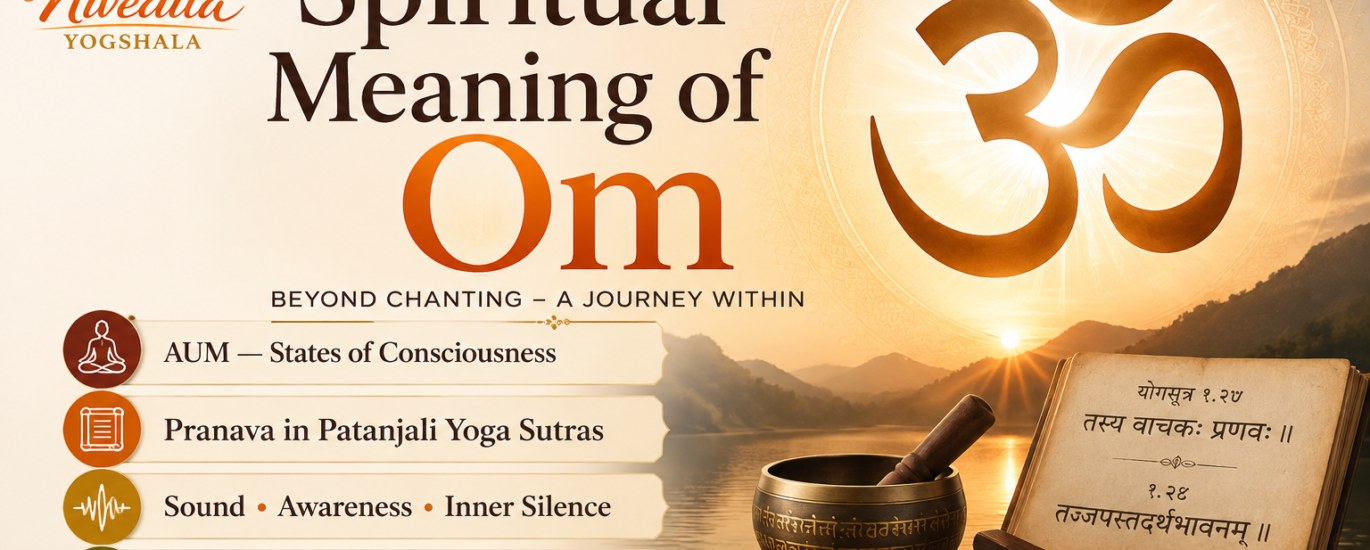




If you have ever attended a yoga class, meditation session, or spiritual gathering, you have probably heard the sound Om — ॐ. It may be chanted at the beginning of a practice, at the end, or sometimes three times in succession. The sound is familiar to almost every yoga practitioner, yet very few of us stop to ask a simple question: What does Om actually mean?
Is Om merely a mantra? Is it a sacred symbol? Is it a vibration used to calm the mind? Or does it point toward something much deeper?
The Spiritual Meaning of Om cannot be understood simply by translating the word. In the yogic tradition, Om is known as Pranava (प्रणव) and carries profound philosophical significance. It appears in the Upanishadic tradition and is given an important place by Maharshi Patanjali in the Yoga Sutras.
When we first encounter Om, we notice its sound. With practice, we begin to notice its vibration. But if we continue with awareness, something subtler begins to reveal itself—the silence from which the sound arises and the silence into which it eventually disappears.
Perhaps the deepest teaching of Om begins where the sound ends.
What Is Om (ॐ)?
Om is among the most ancient sacred syllables found in Indian spiritual traditions. It is often written as AUM, which helps us understand that what appears to be a single sound contains different stages within it.
When Om is chanted slowly and consciously, we can experience the movement of A—U—M. The sound begins openly with “A,” gradually moves through “U,” and closes at the lips with “M.” After M fades away, there is a brief period of silence.
This movement from sound into silence is not merely a method of pronunciation. Yogic and Upanishadic traditions use it to contemplate the nature of consciousness itself. Om therefore becomes much more than something we chant; it becomes something we observe, experience, and gradually contemplate.
The Spiritual Meaning of Om
To understand the Spiritual Meaning of Om, first observe how we normally experience life. We divide our existence into countless pieces: my body, my thoughts, my family, my work, my achievements, my problems, my happiness and my suffering. Our attention moves continuously among these changing experiences, and eventually we begin identifying ourselves with them.
Yoga asks a deeper question: Who is aware of all these experiences?
You know when your body is tired. You know when a thought appears. You know when anger arises and when it begins to disappear. You know when you are happy, worried, peaceful or restless. Everything keeps changing, yet there is an awareness through which these changes are known.
Om becomes a profound symbol for contemplating this larger reality of consciousness and existence. This is why merely repeating Om mechanically cannot reveal its complete significance. The sound invites japa, but it also invites bhāvanā—deep contemplation of what is being repeated.
Why Is Om Written as AUM?
The philosophical significance of A-U-M becomes particularly beautiful when we turn toward the Mandukya Upanishad, a short but profound Upanishad centered on Om and consciousness.
The teaching examines the human experience through different states of consciousness. The sounds A, U and M are associated with three familiar states—Jāgrat, Svapna, and Suṣupti—while the teaching ultimately points beyond these toward Turīya, “the fourth.”
These are not merely abstract philosophical concepts. We experience the first three every day. We wake, we dream, and we sleep deeply. The wisdom lies in observing what these ordinary experiences may reveal about consciousness.
A — Jāgrat: The Waking State
The sound A is associated with Jāgrat, our waking state. This is the state in which you are reading these words. Your senses are directed toward the external world. You see objects, hear sounds, interact with people, work, eat, travel, speak and make decisions.
Most of what we ordinarily call “my life” takes place in this waking experience. Because it occupies so much of our attention, we easily begin to assume that this is the whole of our existence.
But every night, this familiar world recedes and another kind of experience appears.
U — Svapna: The Dreaming State
The sound U is associated with Svapna, the dream state. While dreaming, the external world is no longer experienced in the same way, yet another world may arise within the mind. We can experience people, places, happiness, fear, movement and entire sequences of events.
For a yoga practitioner, this is worth contemplating. It shows us how powerful the mind can be. An experience can feel remarkably real while it is occurring, even when its objects arise within a dream.
The yogi therefore learns not to accept every mental movement as absolute truth. Thoughts, images and emotions are observed with increasing awareness.
M — Suṣupti: The Deep Sleep State
The sound M is associated with Suṣupti, or deep sleep. In deep sleep, the ordinary activity of the senses, waking thoughts and dream experiences is absent in the way we normally know them.
When we awaken, however, we may say, “I slept peacefully,” or “I slept deeply.” The Upanishadic tradition takes this familiar human experience and uses it as a doorway into a much deeper inquiry about consciousness.
Yet A-U-M does not end with M.
The sound disappears.
And then there is silence.
The Silence After Om: Understanding Turīya
When you next chant Om, resist the urge to immediately begin another repetition. After the final “M” has faded, remain still for a few moments and listen.
The sound is gone, but awareness has not necessarily disappeared.
The Mandukya teaching points toward Turīya, literally “the fourth.” It should not simply be understood as a fourth ordinary state added to waking, dreaming and deep sleep. Rather, it points beyond the usual categories through which we understand our experiences.
This is where the Spiritual Meaning of Om becomes remarkably subtle. A arises, U continues, M dissolves, and silence follows. In much the same way, our experiences continually arise and disappear. Thoughts come and go. Emotions come and go. Pleasure and discomfort change. Waking gives way to dreaming, dreaming to deep sleep, and deep sleep again to waking.
Yoga invites us to inquire into that which is not merely another passing thought or emotion.
It asks us to observe the awareness in which change itself is known.
What Maharshi Patanjali Says About Om
Maharshi Patanjali gives Pranava an important place in the Yoga Sutras. In Yoga Sutra 1.27, he states:
तस्य वाचकः प्रणवः॥
Tasya vācakaḥ praṇavaḥ.
— Yoga Sutra 1.27
In this context, Pranava—Om—is presented as the designation or expression of Ishvara.
The next sutra makes the practice even clearer:
तज्जपस्तदर्थभावनम्॥
Tajjapastadarthabhāvanam.
— Yoga Sutra 1.28
This short sutra contains an important lesson. Patanjali speaks not only of japa, or repetition, but also of contemplation of its meaning. The practitioner is therefore not being instructed merely to produce a sound again and again. The repetition is accompanied by awareness and reflection on what Pranava signifies.
This distinction is essential. If Om becomes only a habit at the beginning of a yoga class, much of its contemplative value can be missed. When sound, attention and meaning come together, chanting begins to become sādhanā.
Om as Pranava
In yogic literature, Om is frequently called Pranava. An ordinary word generally directs the mind toward an object. When someone says “river,” we imagine a river. When someone says “tree,” the mind forms an idea of a tree.
Pranava is different. It invites the practitioner toward something that cannot be reduced to an ordinary physical object. Instead of continually directing attention outward, its practice can become a means of turning awareness inward.
This is one reason Om has remained so deeply associated with meditation and spiritual practice. The purpose is not simply to hear a beautiful sound but to use that sound as a doorway toward deeper awareness.
Why Do We Chant Om Before Yoga Practice?
Many yoga classes begin with Om, but repetition can easily become routine. The teacher chants, the students follow, and within moments everyone moves on to the physical practice.
If we approach it consciously, however, Om can serve as a meaningful transition between everyday activity and yogic practice. We often arrive on the mat carrying our entire day with us—work, family responsibilities, conversations, notifications, plans, memories and worries.
A few slow repetitions of Om give us an opportunity to gather that scattered attention. Breathing becomes more deliberate, awareness turns toward the present moment, and the practitioner begins moving from constant doing toward conscious observation.
The asana practice can then begin from a different place—not merely with movement, but with awareness.
What Happens When We Chant Om Mindfully?
Om should not be reduced to exaggerated claims about curing illnesses or producing instant spiritual experiences. Its traditional significance is much deeper than such promises.
When Om is chanted slowly and attentively, the practitioner can observe the breath, the movement of sound, the vibration, the gradual fading of the vibration and finally the silence that follows. Instead of allowing attention to run behind dozens of thoughts, we offer the mind a single object of awareness.
This is why the quality of practice matters more than the loudness or duration of the chant. There is no need to perform Om for anyone else. A beautiful voice is not required, nor is an unusually long breath.
Om is not meant to impress the person sitting beside you. It is meant to turn your awareness inward.
A Simple Om Practice for Beginners
If you are beginning, there is no need to make the practice complicated. Sit comfortably in Sukhasana, Vajrasana, Padmasana, or even on a chair if sitting on the floor is uncomfortable. The spine can remain naturally upright while the shoulders, face and jaw stay relaxed.
Patanjali gives us a wonderfully simple principle for posture:
स्थिरसुखमासनम्॥
Sthira-sukham āsanam.
— Yoga Sutra 2.46
The posture should have steadiness as well as ease.
Close your eyes gently and take a comfortable breath inward. As you exhale, allow the sound to unfold naturally as Aaaa—Uuuu—Mmmm. Do not strain your throat or force yourself to prolong the breath. When the sound finishes, remain quiet for a few moments before taking the next breath.
For a beginner, three conscious repetitions can be enough. Over time, the practice may deepen naturally. The aim is not to accumulate a large number of repetitions but to bring greater awareness to each repetition.
Do Not Miss the Silence
If I were to give a beginner only one suggestion about Om practice, it would be this: do not hurry past the silence.
We usually pay attention to what we can hear. We concentrate on producing A, U and M correctly, making the chant steady and feeling its vibration. Yet when the sound disappears, we often immediately inhale and begin again.
Try something different. Let the sound end completely. Remain there for a few moments without producing anything. Do not search for a special experience and do not ask whether you are “doing it correctly.” Simply notice the stillness that follows.
The sound required effort. The silence does not.
This small observation can gradually transform our relationship with the practice.
Om Is Not Just a Sound—It Is an Experience
We can read books about the Spiritual Meaning of Om, study Sanskrit terminology, explore commentaries on the Yoga Sutras and examine the Mandukya Upanishad. Such study is valuable because it protects us from reducing profound yogic ideas to superficial explanations.
But yoga ultimately asks us to practice.
You cannot fully understand sweetness by reading a description of sugar. At some point, it must be tasted. In the same way, the philosophy of Om can show us the direction, but attentive practice allows us to explore what those teachings mean within our own experience.
Chant the sound. Listen to it. Notice its fading. Remain silent. Observe what happens within you.
There is no need to hurry toward a conclusion.
The Yogi’s Journal
For a long time, I believed that the most important part of Om was the sound itself. My attention remained on making the chant steady, deep and continuous. Like many practitioners, I listened carefully to the vibration and tried to improve the quality of the sound.
With continued practice, however, my attention slowly shifted toward something I had previously ignored. I began noticing the moment immediately after the chant ended. The vibration became subtler, the sound disappeared, and for a brief moment there was nothing that needed to be produced.
Only silence remained.
Gradually, I stopped asking myself, “How beautifully can I chant Om?” Another question became more meaningful: “Can I remain aware when the sound has disappeared?”
That question changed the practice for me. Life itself is filled with sounds, thoughts, actions, identities and experiences. They arise, remain for some time and eventually pass away. Beneath all this movement, yoga invites us to discover stillness—not necessarily by creating it, but by becoming quiet enough to notice it.
Final Reflection
The Spiritual Meaning of Om cannot be contained within one definition. Om is a sacred mantra, it is Pranava, and it is an important object of contemplation within yogic philosophy. The Mandukya Upanishad uses A-U-M to explore waking, dreaming and deep sleep while pointing toward Turīya. Patanjali connects Pranava with Ishvara and instructs the practitioner to combine its repetition with contemplation of its meaning.
So the next time you chant Om, do not rush through it. Allow A to arise naturally, let U flow, and allow M to dissolve completely. Then remain quiet for a few moments.
You may have chanted Om hundreds of times before. This time, listen differently.
Sometimes the deepest teaching of Om begins only after the sound has ended.
Frequently Asked Questions
What is the spiritual meaning of Om?
The spiritual meaning of Om is associated with consciousness, wholeness and deeper inquiry into the nature of experience. In the Mandukya Upanishad, A-U-M is used to contemplate waking, dreaming and deep sleep, along with Turīya, which points beyond the ordinary three states.
What does AUM represent?
A, U and M are traditionally associated with Jāgrat (waking), Svapna (dreaming), and Suṣupti (deep sleep) in the Mandukya teaching. The silence associated with Om is significant in its discussion of Turīya.
What does Maharshi Patanjali say about Om?
Yoga Sutra 1.27 describes Pranava as the designation or expression of Ishvara. In Yoga Sutra 1.28, Patanjali instructs the practitioner to engage in its japa together with contemplation of its meaning.
Why is Om chanted before yoga?
When practiced consciously, Om chanting can help mark the transition from ordinary daily activity into a more attentive yogic practice. It gives the practitioner an opportunity to settle the breath, gather attention and turn awareness inward.
How many times should a beginner chant Om?
A beginner can start with three comfortable, mindful repetitions. There is no need to force the breath or pursue a particular duration. Awareness and ease are more important than the number of repetitions.
Why should we remain silent after chanting Om?
The pause allows us to observe the transition from sound to stillness. Rather than immediately producing another sound, the practitioner can simply remain aware of the silence that follows. This also connects beautifully with the contemplative significance of Om described in the Mandukya tradition.