



Mental Silence has become increasingly rare in today’s world.
From the moment we wake up until we fall asleep, our minds are surrounded by notifications, conversations, screens, music, news, advertisements, and endless streams of information. We are constantly connected, yet many people feel mentally exhausted, emotionally drained, and disconnected from themselves.
Most people believe that physical fatigue is the greatest challenge of modern life. However, mental exhaustion is often far more damaging. A restless mind struggles to focus, make decisions, manage emotions, and experience peace.
In yogic philosophy, silence is not merely the absence of sound. Silence is a state of inner stillness where the mind becomes calm and awareness becomes clear.
Maharshi Patanjali beautifully explains:
“योगश्चित्तवृत्तिनिरोधः”
Yoga is the calming of the fluctuations of the mind.
This teaching reminds us that true peace begins when mental noise begins to settle.
If you constantly feel overwhelmed, irritated, distracted, or emotionally exhausted, your mind may be asking for something very simple yet powerful: silence.
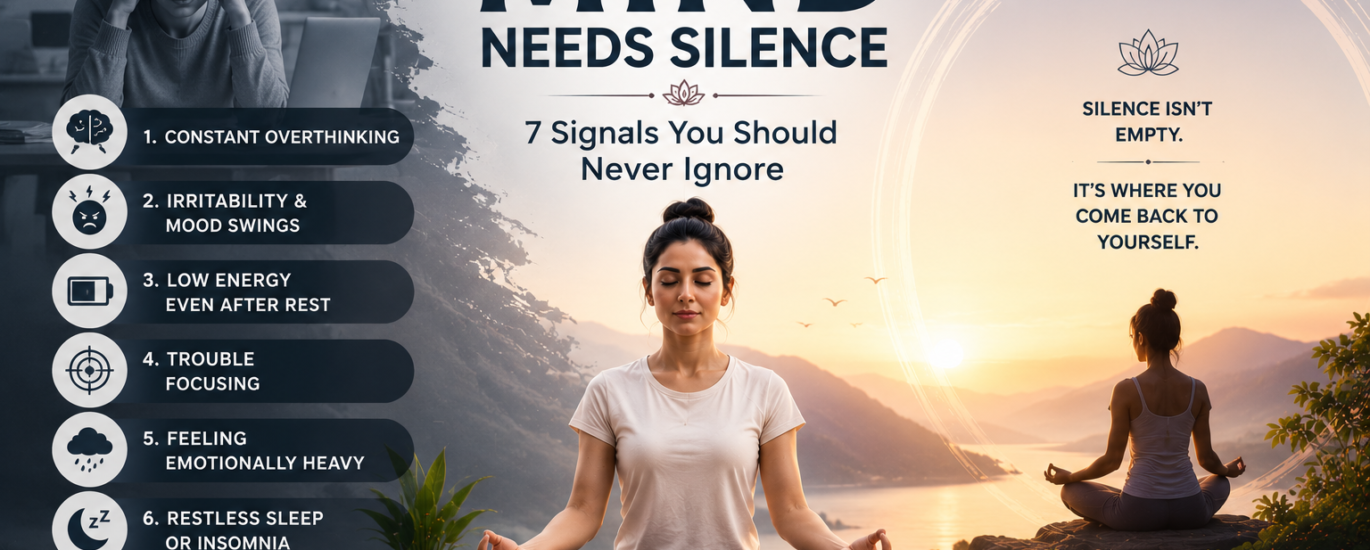
Let us explore seven important signs that indicate your mind needs Mental Silence.
Why Mental Silence Matters
Mental Silence is not about escaping responsibilities or avoiding life.
It is about creating space within the mind. Just as the body needs rest after physical activity, the mind also requires periods of stillness to recover from constant stimulation. Without silence, the mind remains trapped in continuous activity. Thoughts become repetitive, emotions become reactive, and attention becomes scattered.
Regular periods of silence may help:
- Improve focus
- Reduce stress
- Increase emotional balance
- Improve decision-making
- Enhance creativity
- Promote inner peace
Ancient yogic traditions understood this long before modern science began studying mindfulness and meditation.
What Ancient Yogic Wisdom Says About Silence
The goal of yoga is not simply physical flexibility. Yoga ultimately aims to quiet the mind and reveal our true nature.
Patanjali further teaches:
“तदा द्रष्टुः स्वरूपेऽवस्थानम्”
Then the Seer rests in his own true nature.
This means that when mental disturbances settle, we reconnect with our authentic self. Silence allows us to hear the wisdom that is often drowned out by constant mental activity.
Sign #1: You Constantly Need Stimulation
One of the clearest signs that your mind needs Mental Silence is an inability to sit quietly.
You may notice that you always need:
- Your phone
- Music
- Television
- Podcasts
- Social media
- Constant conversation
Being alone with your thoughts feels uncomfortable.
Whenever there is a moment of quiet, you immediately reach for a device or seek distraction. This behavior often indicates that the mind has become dependent on stimulation. Silence feels uncomfortable because the mind has forgotten how to rest.
Sign #2: Your Thoughts Never Slow Down
Do you feel as though your mind is constantly talking? Many people experience endless mental conversations throughout the day.
The mind jumps from:
- Future worries
- Past regrets
- Work responsibilities
- Personal concerns
- Random thoughts
Even during rest, the mental activity continues. A constantly active mind rarely experiences true relaxation. Mental Silence helps create distance from excessive thinking and allows the mind to settle naturally.
Sign #3: Small Things Irritate You Easily
Another important sign is increased irritability. When the mind becomes overloaded, patience often decreases. Minor inconveniences suddenly feel overwhelming.
You may become frustrated by:
- Traffic
- Delays
- Noise
- Small mistakes
- Other people’s behavior
Often, the problem is not the situation itself. The mind is simply carrying too much mental and emotional tension. Silence helps release this accumulated pressure.
Sign #4: You Feel Mentally Exhausted Even After Rest
Physical rest does not always restore mental energy. Many people sleep for several hours yet still wake up feeling exhausted.
Why? Because the mind never truly stops.
Mental exhaustion often appears as:
- Brain fog
- Lack of motivation
- Difficulty concentrating
- Emotional fatigue
- Feeling overwhelmed
In such situations, the mind often needs silence more than stimulation. A few moments of mindful stillness can sometimes be more restorative than hours of passive entertainment.
Sign #5: You Struggle to Be Alone with Yourself
Many people fear silence because silence reveals what they have been avoiding.
When distractions disappear, unresolved emotions often become visible. As a result, people remain constantly occupied. They stay busy not because they enjoy it, but because they fear being alone with their thoughts.
Mental Silence invites self-awareness. Although this can feel uncomfortable initially, it often becomes the doorway to emotional healing and personal growth.
Sign #6: Your Focus Has Declined
One of the biggest consequences of constant stimulation is reduced attention span.
Many people find it difficult to:
- Read a book
- Complete a task
- Stay present in conversations
- Focus during meditation
The mind becomes conditioned to seek constant novelty.
Mental Silence helps retrain attention. Through silence, breathing awareness, and meditation, the mind gradually regains its ability to concentrate. This is one reason yoga and mindfulness practices remain so effective in modern life.
Sign #7: You Feel Disconnected from Yourself
Perhaps the most important sign is feeling disconnected from your own life. You may continue fulfilling responsibilities, yet something feels missing.
Many people describe this as:
- Feeling empty
- Feeling lost
- Lack of purpose
- Lack of inner joy
- Emotional numbness
The external world becomes louder while the inner world becomes quieter. Mental Silence helps restore this connection. When the noise begins to fade, clarity often emerges.
How Yoga Helps Create Mental Silence
Yoga is one of the most effective ways to cultivate Mental Silence naturally.
Unlike ordinary exercise, yoga combines:
- Movement
- Breath awareness
- Relaxation
- Mindfulness
- Meditation
This combination helps calm both the body and mind simultaneously. Many of the Daily Yoga Benefits extend beyond physical fitness and directly support mental well-being.
Regular yoga practice may help:
- Reduce mental chatter
- Improve emotional balance
- Enhance focus
- Lower stress levels
- Increase self-awareness
If you are beginning your journey, you may also enjoy our articles on Morning Yoga Benefits and Yoga for Anger Management.
Simple Practices to Cultivate Silence
You do not need a retreat in the mountains to experience Mental Silence. Small daily practices can create meaningful change.
Consider:
Mindful Breathing
Spend five minutes observing your breath without distractions.
Silent Walking
Walk slowly without music or a phone.
Meditation
Sit quietly and observe thoughts without judgment.
Digital Detox
Spend one hour each day away from screens.
Yoga Practice
Gentle yoga postures combined with breathing awareness help prepare the mind for silence. Consistency matters more than duration. Even a few minutes each day can create noticeable benefits.
The Hidden Gift of Silence
Most people seek peace by changing external circumstances. Yoga teaches a different approach. Peace does not come from controlling everything around us. Peace arises when the mind becomes quieter.
- Silence allows us to see clearly.
- Silence helps us respond rather than react.
- Silence reconnects us with ourselves.
The ancient yogis understood that true wisdom emerges not from constant activity but from stillness.
Final Thoughts
Mental Silence is not a luxury. It is a necessity.
In a world filled with constant stimulation, learning how to be still may be one of the most valuable skills we can develop. If you recognize several of the signs discussed in this article, consider it an invitation from your mind to slow down.
Through yoga, mindful breathing, meditation, and moments of intentional stillness, it is possible to create space for clarity, balance, and inner peace.
As Maharshi Patanjali reminds us, yoga begins when the fluctuations of the mind become calm. And often, that journey begins with a few moments of silence.
FAQ Section
What is Mental Silence?
Mental Silence is a state of inner calm where excessive thoughts and mental distractions begin to settle, allowing greater clarity and awareness.
Why does my mind constantly need stimulation?
Continuous exposure to digital devices, social media, stress, and multitasking can condition the mind to seek constant stimulation.
Can yoga help create Mental Silence?
Yes. Yoga combines movement, breathing, relaxation, and mindfulness, which can help calm mental activity and promote inner stillness.
How can I practice silence daily?
Mindful breathing, meditation, silent walking, digital detox periods, and regular yoga practice are simple ways to cultivate silence.
How long does it take to experience the benefits of silence?
Many people notice improved calmness and focus within a few days of consistent practice, while deeper benefits develop over time.