



Among the countless sages who have shaped the spiritual heritage of India, few have had as profound an influence as Maharshi Patanjali. Although thousands of years have passed since his teachings were first shared, his wisdom continues to guide yoga practitioners, spiritual seekers, scholars, and meditation enthusiasts around the world.
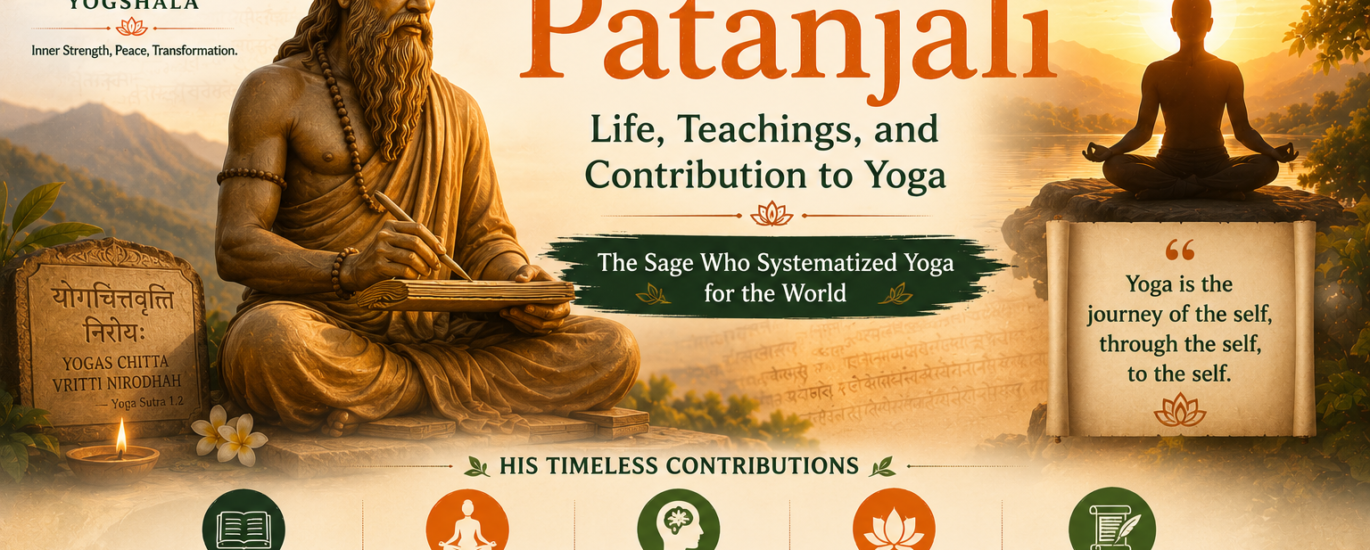
Whenever yoga is discussed beyond physical postures, the name Maharshi Patanjali naturally emerges. He is widely regarded as the father of Classical Yoga because he organized and systematized the philosophy and practice of yoga through his famous text, the Yoga Sutras.
Today, millions of people practice yoga for health, flexibility, stress relief, and mindfulness. Yet the deeper roots of yoga can be traced back to the teachings of Maharshi Patanjali, whose insights continue to illuminate the path toward inner peace and self-realization.
Who Was Maharshi Patanjali?
Maharshi Patanjali was an ancient Indian sage, philosopher, and scholar whose exact historical period remains uncertain. Various traditions place him between the 2nd century BCE and the 4th century CE.
While historical details about his personal life are limited, his intellectual and spiritual contributions have survived through centuries.
Patanjali is traditionally credited with three major contributions:
- The Yoga Sutras (Yoga Philosophy)
- Mahabhashya (Sanskrit Grammar Commentary)
- Contributions to Ayurveda
Because of these achievements, he is often revered as a master who purified the mind through yoga, speech through grammar, and the body through Ayurveda.
The traditional invocation dedicated to Patanjali beautifully expresses this reverence:
योगेन चित्तस्य पदेन वाचां
मलं शरीरस्य च वैद्यकेन ।
योऽपाकरोत्तं प्रवरं मुनीनां
पतञ्जलिं प्राञ्जलिरानतोऽस्मि ॥
Meaning:
“I bow with folded hands to the noble sage Patanjali, who removed impurities of the mind through yoga, impurities of speech through grammar, and impurities of the body through Ayurveda.”
This verse remains one of the most widely recited prayers in yoga traditions today.
The Birth and Legends of Maharshi Patanjali
Like many ancient sages, Maharshi Patanjali’s life is surrounded by inspiring legends.
One popular tradition describes him as an incarnation of Adishesha, the divine serpent upon whom Lord Vishnu rests.
According to the legend, a devoted yogini named Gonika prayed for a worthy student to whom she could transmit her spiritual knowledge. As she offered water to the rising sun, a tiny serpent descended into her cupped hands and transformed into a child.
Because he “fell” (pat) into her folded hands (anjali), he became known as Patanjali.
Whether understood literally or symbolically, this story reflects the reverence with which ancient India viewed his spiritual wisdom.
Maharshi Patanjali and the Yoga Sutras
The greatest contribution of Maharshi Patanjali is undoubtedly the Yoga Sutras.
This remarkable text consists of 196 concise aphorisms known as sutras. Despite their brevity, these sutras contain profound teachings about the nature of the mind, suffering, self-discipline, meditation, and spiritual liberation.
The Yoga Sutras are divided into four chapters:
- Samadhi Pada
- Sadhana Pada
- Vibhuti Pada
- Kaivalya Pada
Together, they provide a complete roadmap for spiritual development.
The very second sutra contains one of the most famous definitions of yoga:
योगश्चित्तवृत्तिनिरोधः ॥
Yoga is the cessation of the fluctuations of the mind.
This simple yet profound statement remains one of the foundational teachings of yoga philosophy.
According to Patanjali, yoga is not merely physical exercise. It is a systematic method for calming the mind and realizing one’s true nature.
The Meaning of Yoga According to Patanjali
Modern yoga is often associated with physical postures and flexibility. While these practices are valuable, Patanjali presents a much deeper understanding.
For Maharshi Patanjali, yoga is a process of inner transformation.
He teaches that human suffering often arises from uncontrolled thoughts, attachments, fears, and ignorance about our true nature.
When mental disturbances are reduced, a person experiences clarity and inner peace.
Patanjali explains:
तदा द्रष्टुः स्वरूपेऽवस्थानम् ॥
Then the Seer abides in his own true nature.
In other words, when the mind becomes calm, we experience our authentic self.
This remains one of the central goals of yoga.
The Eight Limbs of Yoga
One of Maharshi Patanjali’s most significant contributions is the concept of Ashtanga Yoga, or the Eight Limbs of Yoga.
These eight limbs provide a practical framework for personal growth and spiritual development.
1. Yama
Ethical principles guiding behavior toward others.
2. Niyama
Personal disciplines and self-observances.
3. Asana
Steady and comfortable postures.
Patanjali states:
स्थिरसुखमासनम् ॥
A posture should be steady and comfortable.
4. Pranayama
Regulation and expansion of life-force through breath control.
5. Pratyahara
Withdrawal of the senses from external distractions.
6. Dharana
Concentration and focused attention.
7. Dhyana
Meditation and uninterrupted awareness.
8. Samadhi
The highest state of spiritual absorption and liberation.
Together, these eight limbs form a comprehensive path for holistic living.
Maharshi Patanjali’s Contribution to Yoga
The importance of Maharshi Patanjali cannot be overstated.
Before the Yoga Sutras, yogic knowledge existed in various traditions and teachings. Patanjali organized these principles into a clear and systematic framework.
His contributions include:
- Defining yoga philosophically
- Providing a practical path for self-development
- Establishing the Eight Limbs of Yoga
- Explaining meditation systematically
- Offering guidance for overcoming mental suffering
- Preserving ancient yogic wisdom
Because of these contributions, he is often called the Father of Classical Yoga.
Virtually every modern yoga tradition is influenced, directly or indirectly, by his teachings.
Patanjali’s Relevance in Modern Life
Although written centuries ago, the teachings of Maharshi Patanjali remain remarkably relevant.
Modern life is often characterized by:
- Stress
- Anxiety
- Mental overload
- Digital distractions
- Emotional imbalance
Patanjali’s teachings address these challenges directly.
His emphasis on mindfulness, self-discipline, meditation, and ethical living offers practical solutions for many modern problems.
Yoga practitioners today continue to benefit from his wisdom because the human mind has not fundamentally changed.
The same mental challenges described in the Yoga Sutras are still experienced today.
Lessons We Can Learn from Maharshi Patanjali
The life and teachings of Maharshi Patanjali offer several timeless lessons.
First, true yoga extends beyond physical exercise.
Second, consistent practice creates transformation.
Patanjali teaches:
स तु दीर्घकालनैरन्तर्यसत्कारासेवितो दृढभूमिः ॥
Practice becomes firmly established when pursued for a long time with dedication and sincerity.
Third, inner peace comes through self-awareness rather than external achievement.
Finally, personal growth requires patience, discipline, and regular effort.
These teachings remain as relevant today as they were thousands of years ago.
Final Thoughts
Maharshi Patanjali occupies a unique place in the history of yoga and human spirituality.
Through the Yoga Sutras, he provided a timeless guide for understanding the mind, cultivating inner peace, and pursuing self-realization.
His teachings remind us that yoga is far more than physical exercise. It is a path toward harmony, awareness, discipline, and spiritual growth.
Every time we step onto the yoga mat, practice conscious breathing, or sit quietly in meditation, we are participating in a tradition deeply influenced by the wisdom of Maharshi Patanjali.
His legacy continues to inspire millions across the world and serves as a beacon for those seeking a more balanced, meaningful, and conscious life.
FAQ Section
Who was Maharshi Patanjali?
Maharshi Patanjali was an ancient Indian sage best known for compiling the Yoga Sutras, the foundational text of Classical Yoga.
Why is Maharshi Patanjali called the Father of Yoga?
He systematically organized yoga philosophy and practices into the Yoga Sutras, creating a structured framework for spiritual development.
What are the Yoga Sutras?
The Yoga Sutras are a collection of 196 aphorisms that explain the philosophy and practice of yoga.
What is the most famous Yoga Sutra?
“योगश्चित्तवृत्तिनिरोधः” — Yoga is the cessation of the fluctuations of the mind.
What are the Eight Limbs of Yoga?
The Eight Limbs of Yoga are Yama, Niyama, Asana, Pranayama, Pratyahara, Dharana, Dhyana, and Samadhi.